Not sure whether you need dedicated winter tires or if all-weather tires could work for you? We break down the differences and what makes the most sense for Newfoundland roads.
Winter Tires vs. All-Weather Tires: Which Makes More Sense for Newfoundland Drivers?
If you’re shopping for tires before another Newfoundland winter, you may be wondering whether you really need a separate set of winter tires.
All-weather tires have become another option for drivers who want one set of tires they can use year-round. That can sound pretty appealing when the alternative means buying, storing and changing two sets of tires every year.
But are all-weather tires enough for a Newfoundland winter?
The answer depends a lot on where you drive, how often you drive and whether you need to be on the road regardless of the weather.
First, All-Weather and All-Season Tires Aren’t the Same Thing
This is one of the biggest sources of confusion when comparing tires.
Traditional all-season tires are designed to work across a broad range of mild conditions, but their performance begins to decline as temperatures get colder.
All-weather tires are designed for year-round use while also meeting specific snow-traction requirements. Compared with a conventional all-season tire, they offer greater winter capability, but they still have to balance winter performance with warm-weather use.
When comparing tires for winter use, look for the three-peak mountain snowflake symbol, often shortened to 3PMSF. This symbol identifies tires that meet specific snow-traction performance requirements.
It’s important to know that the 3PMSF symbol does not mean every tire carrying it performs the same way in all winter conditions, or that an all-weather tire will perform exactly like a dedicated winter tire. It simply confirms that the tire meets the required snow-traction standard.
What’s Different About a Dedicated Winter Tire?
Winter tires are built specifically around cold-weather performance.
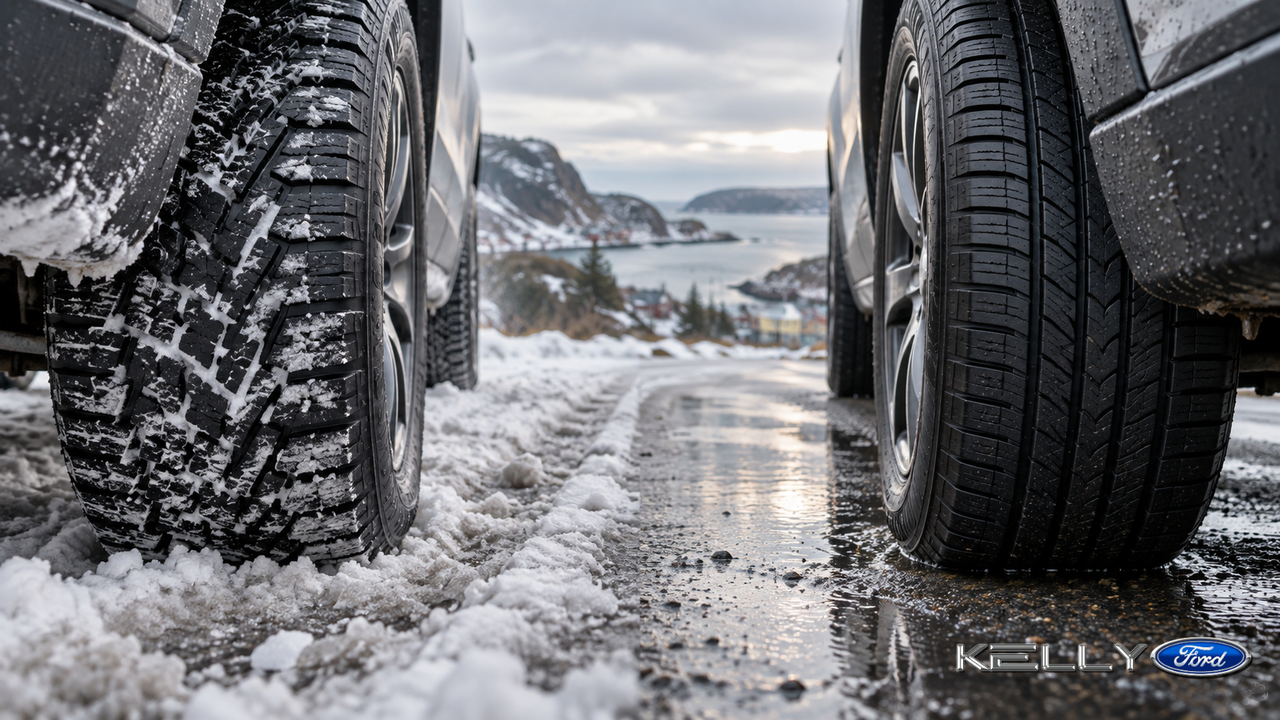
Their rubber compounds are designed to remain flexible as temperatures fall, while their tread patterns and small grooves called sipes are designed to help create traction on snow, ice and slush.
That matters even when the road doesn’t look particularly wintery.
Around 7°C, the compounds used in many conventional all-season tires begin to become less flexible. A dedicated winter tire is designed specifically to continue performing as temperatures fall well below that point.
In Newfoundland, that means winter tires aren’t just about getting through a major snowfall.
They’re also about cold mornings, wet roads approaching freezing, patches of frost, slush, freezing rain and rapidly changing road conditions throughout the season.
So What Is an All-Weather Tire?
An all-weather tire is designed to stay on the vehicle throughout the year while still providing more winter capability than a conventional all-season tire.
For some drivers, that convenience is a major advantage.
You don’t have to schedule seasonal tire changes twice a year, find somewhere to store another set, or own two complete sets of tires.
The trade-off is that an all-weather tire has to do two very different jobs.
It needs to handle warm pavement, rain and summer driving while also providing useful traction in colder temperatures and snow. A dedicated winter tire only has to concentrate on doing the winter job well.
Which Is Better for Newfoundland?
There isn’t one answer that fits every driver.
For many Newfoundland drivers, especially those who spend a lot of time on the road throughout the winter, a dedicated winter set will make the most sense.
Winter tires are already the norm for most drivers in Atlantic Canada. In the Tire and Rubber Association of Canada’s 2025 consumer study, 95% of Atlantic Canadian respondents reported using winter tires.
That doesn’t mean an all-weather tire can’t be the right choice for some drivers, but it does show how strongly drivers in this region tend to lean toward dedicated winter equipment.
Dedicated winter tires may make more sense if you:
- Commute every day regardless of the weather
- Regularly travel the Trans-Canada Highway
- Drive between communities frequently
- Use rural or less frequently cleared roads
- Leave early in the morning or travel at night
- Regularly encounter snow, ice, slush or freezing rain
- Put a lot of kilometres on your vehicle
- Want the most winter-focused tire option available
If the answer to several of those is yes, the inconvenience of seasonal tire changes may be worth the added winter-focused performance.
All-weather tires may be worth considering if you:
- Want one year-round set of tires
- Have flexibility to avoid driving during the worst winter conditions
- Don’t regularly spend long periods driving on snow- or ice-covered roads
- Don’t have room to store another set of tires
- Strongly prefer avoiding seasonal tire changes
The important part is choosing based on how you actually use your vehicle, not simply choosing whichever option sounds more convenient.
What About AWD or 4WD?
Having all-wheel drive or four-wheel drive doesn’t make the tire decision less important.
AWD and 4WD can help your vehicle get moving by sending power to more wheels, but the tires are still the contact points between your vehicle and the road.
Your vehicle still relies on those tires when you brake, steer and try to maintain grip through a slippery corner.
So whether you drive an AWD SUV, a 4x4 truck or a front-wheel-drive vehicle, choosing tires that suit the conditions still matters.
What About Cost?
This is where the comparison becomes a little more complicated.
Choosing one year-round set can eliminate some of the upfront costs associated with owning two seasonal tire sets, although the actual cost difference depends on the tires, whether separate wheels are purchased, installation costs and how long each set lasts.
There’s another part of the equation too.
When you use dedicated winter tires for part of the year, you’re also giving your summer or all-season tires several months off. That spreads your annual kilometres between two sets.
With all-weather tires, the same set handles those kilometres year-round.
How long either option lasts will depend on the tire itself, your annual mileage, wheel alignment, tire pressure, rotation schedule, driving habits and road conditions.
So rather than looking only at the purchase price, it’s worth thinking about how long you plan to keep your vehicle, how much you drive and how many winters you expect to get from your tire setup.
Don’t Choose on the Name Alone
Whether you’re considering winter or all-weather tires, the category printed on the label shouldn’t be the end of the decision.
Look at:
- The three-peak mountain snowflake symbol
- Tire size and vehicle requirements
- Load and speed ratings
- Tread design
- Expected winter conditions
- How much highway versus local driving you do
- Your annual mileage
- Your own comfort level in poor weather
Two drivers with the exact same vehicle could reasonably choose different tires because their driving looks completely different.
Someone commuting between communities every weekday at 7 a.m. has a different winter-driving requirement than someone who mostly drives locally and has the flexibility to stay home when road conditions become poor.
What Makes Sense for Central Newfoundland?
Around Gander and Grand Falls-Windsor, winter doesn’t give us one consistent road condition.
A drive can involve wet pavement, slush, packed snow, ice and clear highway all in the same trip. Temperatures can move above and below freezing, and conditions outside town may be very different from what they were when you left home.
That variability is why the question shouldn’t simply be:
“Are all-weather tires good?”
A better question is:
“Are all-weather tires a good fit for the conditions I need to drive in?”
For a driver who needs dependable mobility throughout a Central Newfoundland winter, dedicated winter tires are generally the more winter-focused option.
For someone with more flexibility and a strong preference for one year-round set, a quality all-weather tire may be worth discussing.
Still Not Sure Which Way to Go?
You don’t need to know the answer before you start shopping.
Tell us what you drive, approximately how much you drive, where you normally travel and what your winters actually look like.
The Kelly Ford team in Gander and Grand Falls-Windsor can help you compare winter and all-weather options that fit your vehicle and your driving needs.
If dedicated winter tires make the most sense, we can also help you look at tire-only options or a complete winter tire-and-wheel setup.
The right answer isn’t necessarily the same for every driver. It’s the tire setup that makes sense for your vehicle, your roads and the way you actually use them.